
I Run Before Sunrise and the Car Glare Still Gets Me
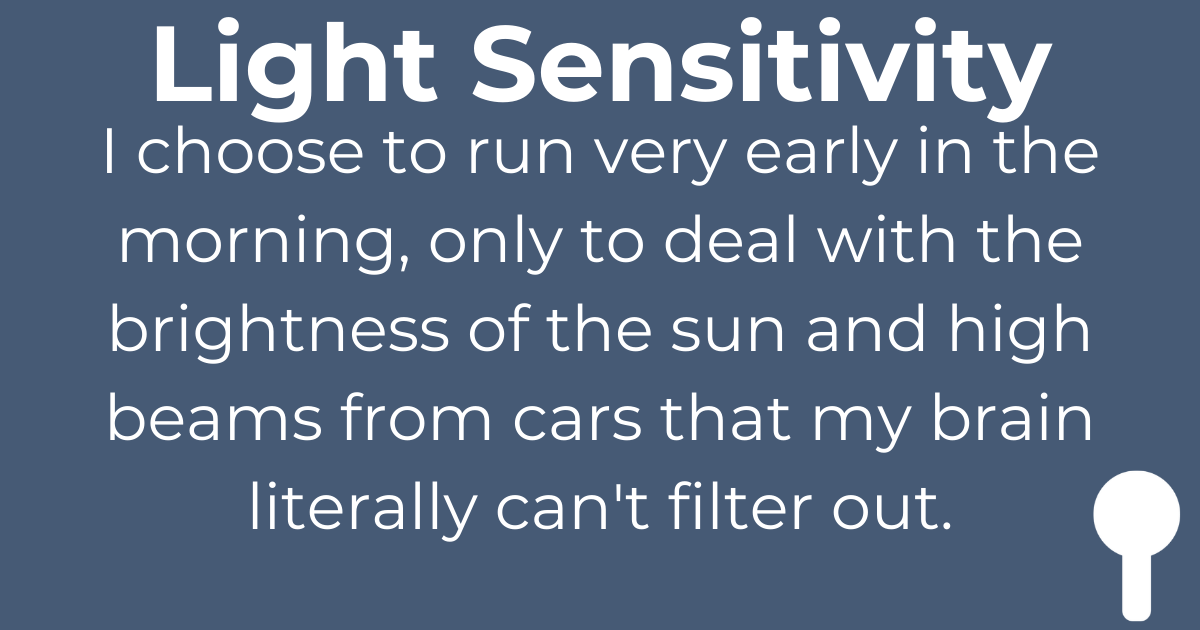
I'm not looking directly at the sun. The brightness of it itself is just far too much for my brain to filter out.
I normally run 5–6 times a week, usually around 5–6AM, right before the sun comes up. Once it does though — even when sunrise is starting — I instinctively tilt my head down and often keep it there for the rest of the hour-long jog.
A few months ago I seemed to pick up on just how sensitive I am to light in general and how it's contributed to many headaches despite not being overwhelmed me elsewhere sometimes.
On mornings I'm headed to work, other cars have their high beams on so I have to look away since it always feels overwhelming to me despite not looking directly at it. I tried running as early as 5-6AM to counter this, but cars suddenly roaring up and their high beams kicking on immediately is both startling and still exhausting from the light itself.
Meanwhile, my brain can do nothing to filter it while also keeping me safe. Closing my eyes is a risk to stepping on the road and possibly getting injured. Earplugs block out noise I clearly need to hear my surroundings and keep me safe, and my sony xm6 noise cancellation headphones have a same risk and impact, and the ambient noise feature lets more sound in, not the other way around. All of this only encouraged my brain to scan even more since that's another factor I can't easily control.
What It Looks Like vs. What's Actually Draining Me
From the outside, it clearly looks like I'm just tired or pushing myself too much. I already have a relatively easy pace I stick to — low aerobic — so the run itself doesn't drain me anywhere near as much as the light sensitivity and constant car navigation does.
Update: As of march 2026 I no longer use pace targets anymore. I just run outside for about an hour and 20 minutes at my own pace which helped a lot.
Inside, I feel my body getting heavier. My pace eventually starts slowing down. I feel more hypervigilant to looking for hazards on the ground so I don't trip, and looking for cars constantly even when I'm walking on the sidewalk. It easily overtakes the exhaustion my runs ever could because my brain never truly gets to be in a flow state and just relax and enjoy itself rather than scanning my surroundings constantly. Physically, more than manageable. Mentally, just barely.
The 1–3 Hours in Bed Afterward
After I'm all done, I go in my room, take my jacket and gloves off, and just spend hours in my bed doing absolutely nothing. Often 1–3 hours if the light sensitivity and car navigation hit me especially hard. Most of the time after my run, or the very next day, I'm having painful headaches. I just wanna lie down and not engage in anything.
The headaches usually come right after I'm done, as well as the mental fatique hit which makes everything else I planned to do especially hard, especially if I have to do it. I still have to make food to eat and check my phone for work update for the week and so on, so it doesn't go away anytime soon.
Exhaustion On Top Of Exhaustion
Using my app's 1-10 energy slider context to simplify this. My energy — usually a 4 or 5 when I got good sleep and sensory overload wasn't that harsh the day before — drops all the way down to 2 after running with sun positioned and beaming down right right where my eyesight is. I feel an immediate need to put off anything requiring cognitive resources, instantly, which results to me mostly doing nothing.
Working on Spoons, drawing, watching videos of cats online — things that often energize me — I'm too exhausted to engage in even those and if I do, it's a minimum effort most of the time. The energy needed for me to start a task, let alone finish it, is extremely difficult. I can't engage in anything during that period without it overwhelming me. Eventually I just outright refused to push through since it's led to so many meltdowns in the past.
It gets me upset sometimes since I clearly intend to work on something I care about. But I'm clearly aware that this environment isn't suitable for me, so I deserve to be able to work on things that don't exhaust me completely.
I've accepted that my current environment is completely unsuitable for running outside. I work out inside the majority of the time, and I don't feel bad about it at all. The only time I do run outside is at around 5am or so when I know my run will be concluded before the sunrise starts, or in the evening when it mostly settled, but to align with my sleep circadium rhythm I vastly prefer the former majority of the time.
About Me & And My Situation
I'm Omari, a 23-year-old autistic adult who's been managing chronic burnout for 5+ years while working warehouse shifts.
This is one of my many reasons I built Spoons. I built it to give clarity on subtle but significant drains like this so I can have energy for both things I need and want to do — like doing laundry and playing games I enjoy in my free time. Noticing my energy constantly dipping down and wanted to get control over it, I invested in light sensitivity glasses, which also come in handy at my warehouse job and make my environment both appear and feel a lot more comfortable.
Launching April 2026. getspoons.app — One email when it's ready. No spam. — Omari
Note: I'm sharing my personal experience as an autistic adult, not medical advice. If you're experiencing severe burnout or crisis, please consult a healthcare provider familiar with autism.