
About Me!
.webp)

Short version: I am Omari, a 23-year old autistic adult. I built Spoons due to my environment at home, work, and life in general being so unaccommodating that I've been stuck in burnout for over 5+ years and have struggled to get out of it. Noises, unpredictability, constant and unexpected demands all piling up while things aren't being accommodated for, so I have to accomadate myself. Full story below ↓
My name is Omari. I'm a 23-year-old autistic adult who lives in North Carolina. I've been in autistic burnout for well over 5 years due to accommodations at work failing me, accommodations at home failing me, and even periods of the day where I'm actively trying to improve my health such as running outside, unpredictable factors such as having to navigate around cars, dogs barking, and the light intensity from the sun has exhausted me so much to the point where I feel forced that I have to do something.
Burnout has essentially made everything in my life harder with virtually zero upside. Getting up out of bed is exhausting. Having to navigate through all of the items and supplements piled up on my floor (since I have limited energy to tidy up my room) is exhausting.
At work, I deal with constant pressure to mask and noise sensitivity. Despite wearing earplugs that block out a lot of sound (NRR 33 DB for example), the intensity and uproar of laughter from coworkers and pressure from managers to not stop working and to take off my Theraspecs light sensitivity glasses (from the intensity of bright light from the warehouse ceiling at my job) is exhausting.
No matter how much sleep I get, no matter how much I plead to managers about why I wear them, and to family members to let me know if anything I need to do in advance rather than abruptly right away has been virtually nonexistent for me personally. We shouldn't have to work around life in an environment that clearly doesn't fully accommodate or respect our very simple and specific needs.
First off, I considered getting my software engineering degree, specifically at WGU. They also allow if I pass the courses a lot faster than the expected timeline which would normally take 4 years for everything, I could bump it down to 1-2 years or even as little as 6 months to get my degree.
Then I realized, after switching from job to job — Target, Bank of America Stadium, and Harris Teeter — even some managers that seem to genuinely care can't fully accommodate me whether they want to but simply can't, or simply see our requests as excuses to be lazy or to have "special treatment."
Accommodations at work specifically didn't really help all that much either. In fact a manager wrote me up when I was wearing blue light glasses, claiming they were sunglasses, despite the fact they were blue light glasses, and we are looking at screens all day. Despite me clearly explaining that, the write-up still went off, and HR basically said "There's nothing we can do." Situations like that happening over and over clearly shows that majority of jobs (but not all obviously) aren't willing to fully accommodate us, especially if they consider their own bias into the equation and see our requests as "issues" and "Why can't you do this job the same as everyone else can, without these requests?"
That's why I ultimately decided to build Spoons. Family isn't going to fully accommodate my neurological differences, work isn't going to, my neighborhood isn't going to, and most public locations aren't going to (at least by default). I felt I needed to see what was specifically draining me (such as noise — I'm extremely sensitive to it, which is why I wear earplugs or Sony XM5 headphones almost every hour of the day) as it was actively keeping me in burnout, and since it felt like no one else was going to help me, what else am I truly supposed to do?
As of right now I work at Amazon. I've been working there for roughly 3 years. This job still doesn't fully accommodate me. As I explained briefly earlier, I had to deal with write-ups for me wearing "sunglasses," but I also got write-ups for kneeling during moments when I needed to rest and regulate myself, either through stimming such as biting my nails, or just brief periods of recovery time through kneeling (not sitting, since I know they have an issue with that) and not doing anything. Managers have wrote me up for this not only once but twice, with the same "There's nothing we can do" mindset whenever I went to complain about it.
Because of this, I always feel on edge, like I never truly relax or accommodate myself completely, such as reading a book despite keeping my time off task to a minimum the whole day, never using my phone at my work station, and mostly keeping to myself. Nothing I ever seem to do there was enough, and I only plan on working here to actively save up for Spoons in regards to my LLC, developer accounts, and anything else I need to pay for.
I figured Spoons as a business could help with that, so I dropped my plans to get my degree and started to work on roughly the same amount of hours I do at Amazon currently (30 hours roughly for each, sometimes 10-20 on low energy weeks).
I've been in burnout for so long that I don't truly remember how long I've been in burnout for. If I were to take an honest guess, it's probably been well over 10 years since I've been in burnout, rather than 5, since I realized that my capacity for masking (with family members, unexpected visits out of town to see extended family, occurring at the jobs I previously worked at, and still to an extent at Amazon despite making as minimum effort as possible to talk with anyone) has declined significantly.
I didn't notice the decline right away, but as of today (March 1st, 2026) of me writing this, I'm quite sure I'm still very deep into burnout. I forget stuff all of the time, small periods of unpredictability, constantly feeling a need to scratch behind my ear, my back when I'm running outside, and also a recent pattern I noticed — my eye twitching at random moments during the day. It doesn't hurt but it is problematic and research shows that it's due to nervous system overload, which burnout has definitely impacted.
It's impacted my sleep significantly too. Some days it's great but most of the time I end up waking up during the middle of the night and having trouble going back to sleep or having constant periods of restlessness according to my smart watch I use to track my sleep. I've tried meditation, eating well, and getting every single possible nutrition I can to help myself feel better yet I'm still in burnout. Sleep for me also makes a modest improvement and any days that I'm not consistent for whatever reason, due to sensory overload or something, it simply extends the timeline and makes me more at risk of being overwhelmed by sensory input, making recovery even harder despite doing my best to maximize it.
I get up relatively early at 4:30 AM, not only because I have to be at work at 7 AM and I leave at 6:30 AM to get there on time, but also due to the sensory overload my family often causes during the day, so getting up that early helps me to minimize that risk.
I wake up, exercise briefly for around 20-30 minutes, and I'm done. The clashing of my dumbbells is extremely overwhelming to me — not only how loud it is, but having to actively process where I am in my family's physical space due to the limited room and not wanting to bump anything and make even more noise.
I put some almond milk, bell peppers, carrots and stuff in the blender alongside my supplements that I take before starting the rest of my day or going to work. Having to plug my ears due to how loud it is and the fact that it persists over a minute. Then I go in the bathroom to wash my face, brush my teeth, etc. I leave my stuff in the bathroom now due to constantly forgetting certain items when I put them back in my room once I'm done, then take them out once I go back in the morning time. I then get in the shower, get dressed, then go in my room. Some days I'll forget to get my lunch before I go to work so I end up exhausted quickly and not eating much since the vending machine items at my workplace are filled with mostly unhealthy items such as candy and processed salads.
I go to work for roughly 10 hours a day, 3 days a week, taking my earplugs and putting them on, never taking them off until I get home (not even in the car when my mom or sister picks me up).
Once I get home, I put my bedtime clothes on, dealing with the chance either my mom or sister comes to my room abruptly without knocking, dealing with the unpredictability costs, or knocking quite loudly (which feels intense to me) and have to deal with that sudden nervous system spike and the light from outside my room, delaying my time to go to sleep even more, sacrificing the quality of said sleep and making burnout even harder to get out of.
Rinse and repeat nearly every day of the week. Even on my days off (despite working 3 days a week) this is still a common occurrence, and it seems like my family doesn't take my concerns seriously enough to make any changes or to help accommodate me. I'm not being selfish when I say that — it's simply something I simply can't handle and it pushes me to have a meltdown so many times, also predictably at this point given how long I've been in burnout.
I don't even know fully how I even have the energy to build Spoons in the first place. Sure, Spoons is obviously a very simple app, but learning programming even just brief amounts to understand my app well enough to not have any issues when actually developing it was extremely hard.
I honestly feel the prospect of being able to not be exhausted at work anymore (at Amazon, or just in general if I'm able to live alone and be able to accommodate every sensory need I can without having to work around anyone) was enough to get me motivated and start taking Spoons development seriously.
I don't remember when I got diagnosed but I got diagnosed when I was a kid (currently 23 as of this year). Back then I didn't pay much attention to my diagnosis given the sensory-related problems or neurological differences — I wasn't very informed about it at the time, nor did it bother me as much. Despite knowing I have trouble socializing with others most (but not all) of the time, it didn't bother me much at all back then and I loved actively meeting and chatting with people, despite some internal struggle with how to navigate small talk and such.
Nearly graduating high school and being an adult for a couple of years now, I've paid a lot more attention to my diagnosis. Not that I devalued it at all — just the neurological differences of being autistic are a lot more apparent now than they ever used to be, and I'm struggling every day in an environment that doesn't seem to fully understand or accommodate me.
I have a few special interests:
- Drawing — I've been into it for a couple of years, despite not seriously pursuing it much (at least not yet!)
- Animation — both creating it and watching it, especially movies from DreamWorks and Disney (Shrek, Puss in Boots, and The Bad Guys)
I aspire to eventually keep working on them as a free-time thing if Spoons manages to do well as a business. Not just animating myself, but watching animated movies is definitely another special interest of mine and is something I want to actively take part of again once my situation changes and I have much more energy to pursue it freely without having to strictly manage my energy all of the time due to my environment.
About Spoons!
Short version: I built spoons to help track my energy to help deal with intense physical and mental exhaustion that I've gotten from being in burnout for the past 5 years. Made to be intentionally simple and frictionless as possible. Full info below ↓
Spoons is quite simply, an app that allows you to track your energy at any given point by simply holding the touch target on the slider, drag it to a certain number (on a scale of 1-10) entirely based on "How much energy do you have right now?" and releasing it, which auto-saves instantly.
I made this app for two reasons. I've been in burnout for over 5+ years at this point and after constantly not being accommodated for despite trying, and dealing with unpredictable demands, loud noises that drain me, and a plethora of other drains that I didn't realize before which tracking helped with, such as:
- The vibration on my phone feeling physically uncomfortable to use
- The light intensity of the sun contributing to eye twitching (specifically on my right eye) occurring either during or afterwards, which left me more exhausted than my run ever did.
I built Spoons to help bring clarity to drains I probably wouldn't have noticed otherwise, and to teach myself to be sustainable within my own limits rather than appealing to neurotypical norms and ways of doing things.
Mood tracking, to-do list apps, even habit tracking. None of these meaningfully address (or at all really) the intense physical and cognitive exhaustion that nearly all of us deal with on a daily basis.
From the demands of most of these apps themselves — with constant "Are you sure?" agreement screens, having to navigate from one screen to the next despite only opening the app to access one thing at that time, and unpredictable loading events that depend on a network connection or a server to sync everything — it made things exhausting and counterproductive since I'm trying to preserve and manage my energy, not burn through it trying to accomplish that same goal.
They also frame it from a mood or habit perspective, such as "How am I feeling?" and streaks such as for habit tracking, which put pressure for us to do more instead of doing less — which is the reason the vast majority of us have been in burnout for so long, often designed by neurotypicals who truly don't understand the neurological differences and pressure we have to deal with on a daily basis just to function or to keep our jobs. Spoons has none of those things.
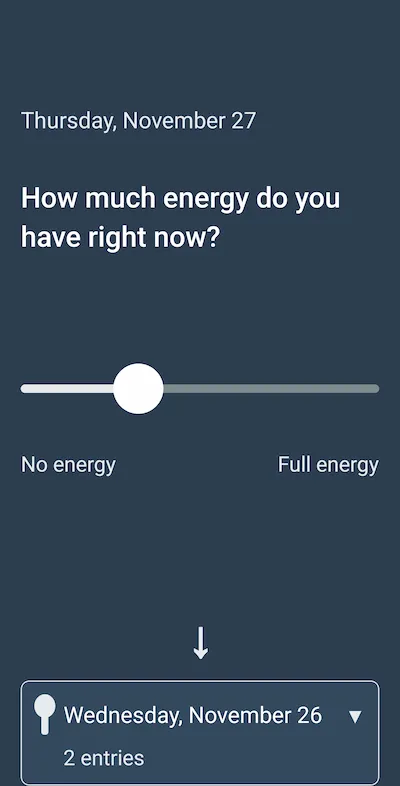
There's not much to Spoons from a functionality standpoint, but that's the entire point. From the minute you open the app, there is one agreement page, which is required for me to put (regarding the privacy policy and TOS stuff), and upon tapping "I agree" it takes you right to the slider.
There's no onboarding, or other bloat and fluff that is unnecessary and would add friction to most of us that have low cognitive resources and are just trying to use the app.
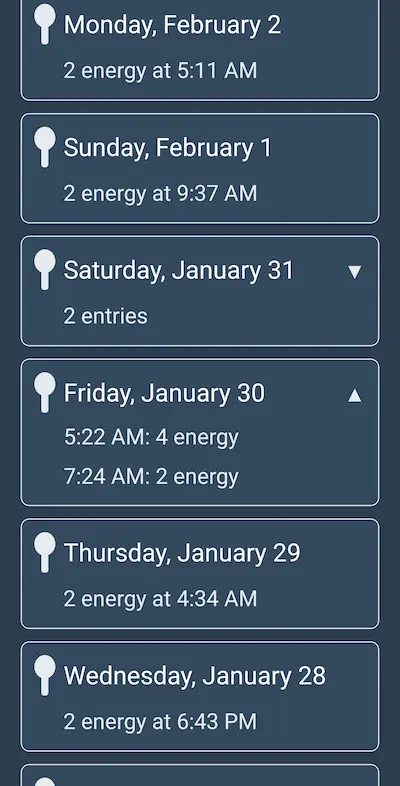
There is a 14-day history view with boxes right below the slider that shows up from the past 14 days if you logged your energy at any point. The first one should come up after the very next day if you interacted with the slider the previous day, and it is listed from earliest to latest, to further reduce the cognitive load and less mental math that we have to deal with to ensure it is as energy-friendly and frictionless as possible. Only what's necessary. Nothing that isn't.
No accounts, no cloud sync servers or a backend (aka servers) for Spoons didn't make sense to add for a few reasons.
The first is that it provides friction when all of us (the majority of us are in burnout or somewhat exhausted to a degree) just want to use the app in the first place. Signing up for an account, then going to Gmail or some other email service to confirm the email, possibly even required to set up 2FA afterward is too much friction. Exporting and importing previous energy logs (which is free and always will be) solves this problem, which also ties to why there is no cloud or servers.
Not only does the importing and exporting of energy logs if you happen to switch devices or reinstall at any point make it redundant, but also a clear privacy concern such as breaches if the worst-case scenario happens. Given how most (but not all obviously) neurotypicals silently judge our way of navigating and doing things, having energy logs attached to no server at all minimizes majority of those concerns, and makes Spoons essentially unhackable given they are unable to access anything, even if they wanted to.
While designing Spoons, I already considered that no notifications nor reminders would even be a "feature" for Spoons — it would just be disabled entirely.
Not only the friction and added energy cost of having to agree for the permissions for those, but constantly having to defer our attention to Spoons rather than allowing us to simply use the app whenever we want to use it, not when some dedicated algorithm or specific recurring time tells us to.
It also involves task-switching (attention from Spoons app → notification → back to app → notification again an hour or so later, via hourly reminder) which is counterintuitive given the purpose of Spoons is to be as frictionless and little energy-costing as possible, so it doesn't make sense at all to even consider it.
Spoons being fully offline ensures there's no crashes or potential server issues that ever arise that make it unusable. The worst-case scenario of Spoons suddenly going offline or a "breach" happening is technically impossible, and it also ensures Spoons is reliable regardless of whether said location has mobile data or a spotty connection, or no connection at all.
Rewards, streaks, or multiplayer additions to Spoons of any kind obviously doesn't make sense in a world that often secretly judges us and encourages us to act or "feel" a certain way. Spoons is an app that allows us to track our energy levels (basically how we feel and what overwhelms, or even replenishes us), and especially since the app has no servers, this doesn't make sense at all either.
The Spoons app interface matches the design of the website itself. This is intentional with the look and feel of the app, as well as making it less cognitive-demanding than an app using all sorts of colors that forces us to divert our attention from one section to the next rather than letting it integrate smoothly.
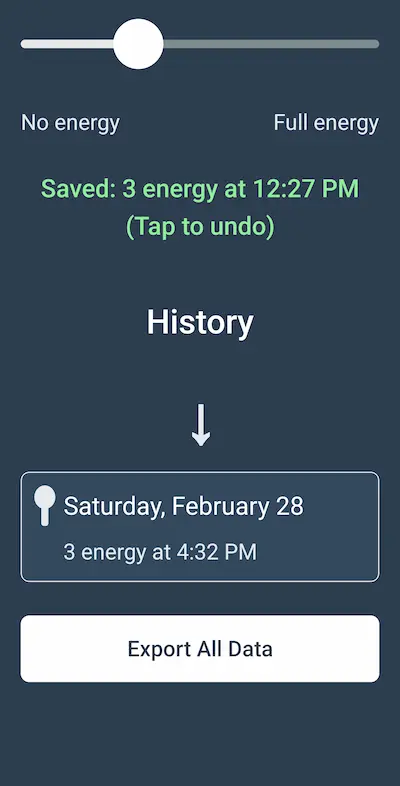
The app interface mostly uses one color of #2C3E50 and only uses shades of white on certain buttons such as the "Export All Data" feature to help it stand out a bit while not being as exhausting as a fully white background would be.
The touch targets (specifically 44px) make it easy to tap and to hold on to at any point. The switches from each number (2 → 3 → 4) are rigid and predictable rather than a smoother slider feel, which would make it feel less predictable and more prone to error, such as choosing an unintended energy level, then having to undo it.
Also, once marking your energy level, "Tap to undo" is always present so you can revert back to the previous level you chose at any point while having the app open. Given how very little memory the app itself uses, the chance of it crashing and negating that specific feature is extremely unlikely.
Most of the app market — heck, society in general — focuses on children when it comes to autism. The majority of apps focus entirely on them, and nothing for us specifically. There are of course some apps that focus on autistic adults like dating and social apps, but addressing the intense exhaustion (let alone autistic burnout) that the majority (but not all) of us face on a daily basis has largely been ignored.
Most neurotypicals don't fully understand the perspective of what we have to deal with every single day, even at home, which is also another reason why it hasn't been addressed meaningfully.
Also, other solutions such as:
- Jobs accommodating us — exists, but doesn't go far enough for most of us
- Therapy — still necessary, but not as effective due to the large gap in clear misunderstanding for what we need.
- At home — where some (but not all) parents treat our decisions to not work or socialize as often as being "lazy" or "not trying hard enough" or even "depressed"
None of these have helped for most of us as much as they should have, so making Spoons feels like the last resort to potentially make things better.
The app itself costs $7.99 a month or $79.99 a year to use. I'm not a big fan of subscriptions either, and you may think it doesn't make sense for an app that has no servers to demand subscription payments every month just to stay afloat. Here are a couple of reasons why I decided to go down this path specifically rather than charging a one-time fee:
The base price is locked forever. For new users, existing, or returning users. This applies to regional pricing as well in countries outside of the US. This is clarified in my terms of service, and never changes for any reason, so the $7.99 monthly price tag will remain $7.99.
Also the history, export, and import will remain free, so if Spoons doesn't make sense for you to pay for right now for any reason, you can always stop paying, then reinstall the app, continue paying for the subscription, import your data back and come back and essentially continue where you left off without losing anything.
A little under a year after Spoons launches (specifically in 2027), the diagnosis funding mission clarified on my mission page (getspoons.app/fund) would be active. A one-time fee, given how a diagnosis cost for a single person in the US costs thousands of dollars on average — a one-time cost to pay and own Spoons forever being $20 would heavily compromise this mission. The gap for us trying to get diagnosed in the first place is getting wider and not meaningfully improving, at least not right now anyway.
This also provides sustainability for Spoons to survive long term — not only being able to afford just enough for the basic necessities (aka the survivability floor, clarified on the mission page) but to fund the mission for many years without compromising on it significantly in both quality and quantity. Also, users who do get a diagnosis funded through Spoons receive a lifetime code that they can use on the app at any point, which is permanent (clarified in detail in my TOS as well).
There's no servers or backend to maintain, so the chance of Spoons "going down" is basically non-existent. As of right now the app development is nearly finished and is planned to release on April 2nd, 2026 as planned.
Also, if Spoons ever goes down and I'm unable to pay for the yearly Apple Developer fee or can't maintain Spoons for whatever reason, the code is released to the entire community for us to use (under AGPL-3.0) so the community can maintain it and continue to use it, entirely for free.
In relation to the diagnosis mission (40% of after-tax income going directly towards this fund), this must be honored if anyone is given permission to continue running Spoons long term. This must be honored or the code goes open-source regardless.
Also, the remaining funds if I happen to pass away or any worst-case scenario occurs and Spoons shuts down, the remaining funds dedicated to the diagnosis mission are donated to existing partner organizations.
No investors can just decide to kill Spoons or change the allocation to "optimize margins," so to speak.
Also, as mentioned before, the price is locked forever for all users (new, existing, returning), so this assists in helping Spoons stay afloat long term, let alone the mission itself.
Questions? hello@getspoons.app