
Recalculating Whether I Can Afford Toothpaste
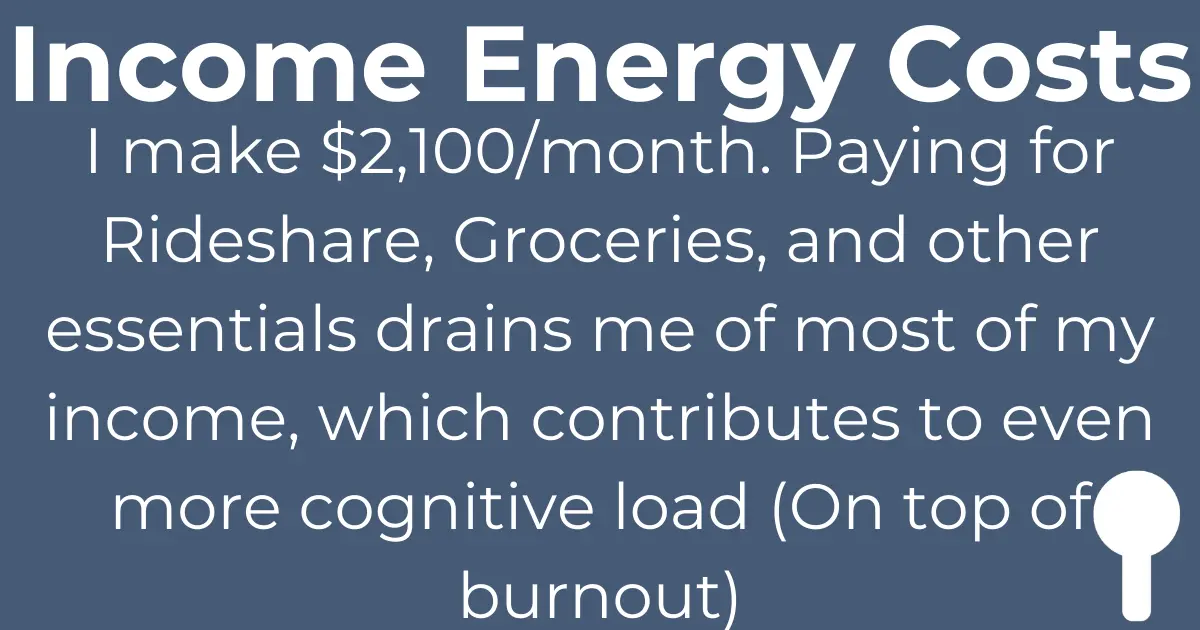
I make $2,100 a month after taxes. By the time I've paid for rideshare, groceries, and essentials, I'm recalculating whether I can afford toothpaste. That recalculating—every day, every purchase—costs me most of my cognitive energy before I start working.
My executive function is already vastly depleted from over five years of burnout. And constant financial planning requires cognitive resources I don't have. (And haven't yet for nearly half a decade now.)
The Rideshare Math
The rideshare costs made this obvious from the start. I get up at 4:30 AM to ensure I have a good enough window to arrive to work and clock in at 7:00 AM. By the time I've had breakfast and put my clothes on—roughly an hour later—I check the prices to see they've increased from $18 to around $25-40. The high end is the most common by far. (Not always, but far more often than not.)
I make around $196 per shift after taxes. Accounting for both rides—morning and evening—I spend $70-80 getting to and from work. That's nearly half my paycheck just to get there.
On top of this, the unpredictability drains me before I leave the house. Either I rush out the door since my ride is arriving in 5 minutes, or I risk being late by waiting 21 minutes, then wait an additional 18-20 minutes to actually arrive. I pay $500 a month for these rides, not including surge pricing, which scales it as high as $700-900 a month. (The high end of what I pay, accounting for 3 rides to, and 3 rides back, per week.)
My Alternatives Got Cut Off
I considered other options to cut this major cost.
The bus does not arrive at predictable times. The stress of knowing whether or not I'd arrive on time quickly withdrew me from trying.
Biking to work is the option I want by far. Using the context of my app's 1-10 energy slider to contextulize the cost, starting at roughly 4 energy most days (Remained around the 2-4 range due to these drains + ongoing burnout) It would still drain me of around 2 energy having to navigate traffic and predict whether others would respect me on the road. But my mom has gone out of her way to make sure I cannot bike to work—removing the bike seat and the attachable headlights and rear lights from my e-bike. I already spent around $1,200 to buy the bike itself, plus the safety gear. My current income doesn't make it feasible to live independently in order to fix that problem.
I've found small but meaningful ways to work around these problems.
Uber's price lock feature helps with predictability somewhat. But prices can still go up due to demand. I only go to work around 12 times a month, and they only have options for 5, 10, 15, or 20 rides. Two of those days I pay without price lock active and risk surge pricing.
For groceries, buying more items in one cart via delivery reduces the chance of being charged an additional $3 per order. It also avoids spending $32-36 round trip to the store while having to navigate around everyone and risk dealing with small talk while still in burnout.
These barely help me. But they're better than nothing, and I'll take anything I can get until my financial situation gets better.
What's Left
$2,100 after taxes. $500-900 on rideshare. $250-320 on groceries. Phone bill, toothpaste, body wash, face wash. What's left varies between almost nothing and actually nothing. (Basically pay check to paycheck) The constant recalculating of whether I can afford essentials this month is its own drain—on top of the burnout I'm already in.\
Update (March 2026): I have started using my flip phone as my primary phone and a barebones phones primarily to use my energy tracking app Spoons to help save on my phone bill, which is now $96 a year instead of the $275 for visible yearly I was paying before.)
About Me
I'm Omari, a 23-year-old autistic adult who's been managing chronic burnout for 5+ years while working warehouse shifts.
I built Spoons to help track my energy and understand how this costs impacted me, and if it would leave any reserves left for anything else. I needed proof that having to constantly manage my low income in an already stressful environment was draining me more than just my finances, and tracking what drains me the most (Such as an unexpected high price at the grocery store, or a high surce price on Lyft) and helps me be more mindful on what specifically is draining me so I can do my best to work around it—since the problem itself is very unlikely to go away. At least not anytime soon.
Launching April 2026. getspoons.app - One email when it's ready. No spam.
— Omari
Note: I'm sharing my personal experience as an autistic adult, not medical advice. If you're experiencing severe burnout or crisis, please consult a healthcare provider familiar with autism.