
Why I Shower Every Other Day in Burnout
Being in burnout significantly impacts my ability to take regular showers and maintain basic hygiene. This isn't something people talk about. Morning showers cost me most of my energy before I even start my day and handle anything else.
The Cold Burst I Can't Stand
Ever since I've been in burnout for the past 5+ years, I find showers immediately disorienting and uncomfortable from a sensory standpoint. When I turn the knob expecting warm water, it's more often than not the opposite—a complete burst of cold water which immediately overwhelms me.
I jitter around and start to pace. I steer to the edge of the shower to minimize how much water is touching my skin. It barely helps and I never enjoy it.
Me being so sensitive to temperature changes in burnout makes every other shower (Rather than daily showers) non-negoitable for me.
Short Showers vs. Long Showers
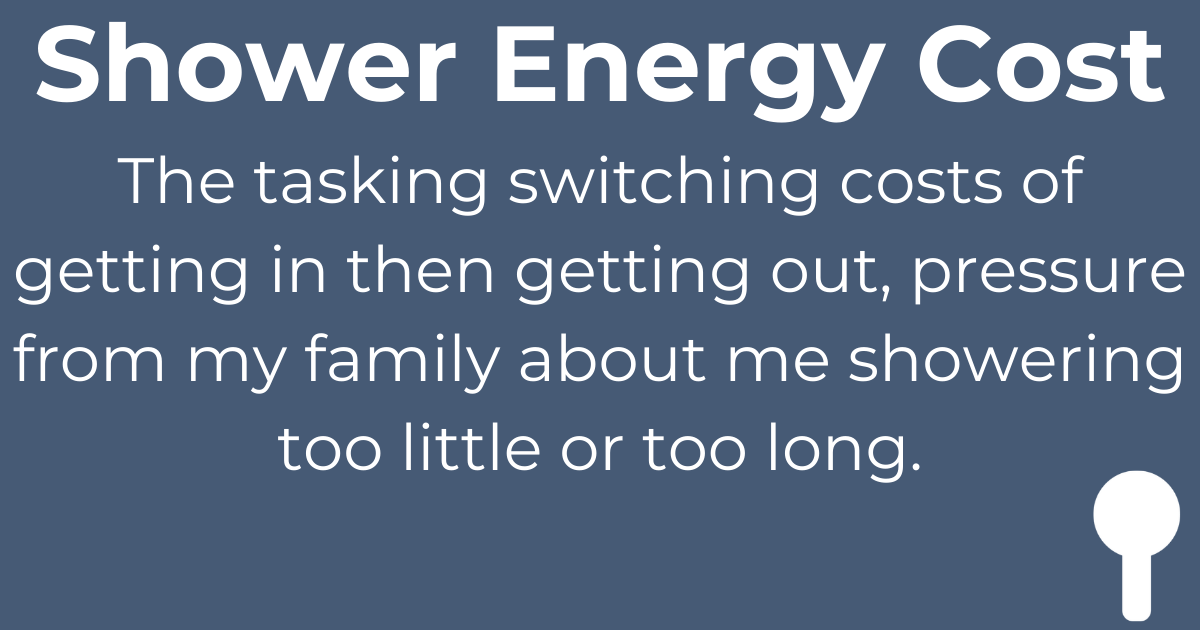
Often times when I get in, family complains about how little and how long I take showers—often as little as 3-4 minutes, or as long as 20-30 minutes.
Short showers happen because of immediate sensory overload. My nervous system basically panics as if something's desperately wrong. The sudden change in temperature directly on my skin is something I cannot stand.
Long showers happen when the temperature is warmish. I'm subconsciously trying to minimize the transition cost of getting out—staying longer helps calm me down before I have to face the cold air, find my towel, dry off, feel my body temperature drop, and deal with the other transition costs and physical tasks: putting clothes on, grabbing lunch from the fridge, setting up a rideshare ride.
I work 3 days a week at my warehouse job. The other 4 days, I shower every other day instead of every day. It gives me a small but meaningful recovery. (Using my app 1-10 energy slider context in mind to explaining the costs) Starting around a 4 most days, showing every other day is still a cost that brings it roughly around a 3 for me, but doing it every other day instead of everyday probably makes it a consistent mild drain instead of a signficantly draining one.
I've thought of waiting until the water is warm enough before hopping in. But the window is variable. In colder months—December, January, February here in Charlotte, North Carolina—it takes a couple minutes longer than expected, adding another layer of unpredictability, especially if I'm in a rush, but it doesn't bother me too much, especially if I start it while I'm brushing my teeth.
On bad shower days, the exhaustion is immediate. Tasks I was looking forward to—writing blog posts, working on Spoons, playing games, or browsing art online on my computer—the motivation disappears. Most involve my special interests: optimizing things, looking at photos of cats, patching bugs in my app. I can technically still do them, but mostly just for a a while before I can't handle it anymore and just do something else instead.
When I wake up and my room is suddenly very cold or very hot, I stay in bed for a couple more hours—even though it barely helps—while I desperately wait for the temperature to get comfortable again. It impacts me for the rest of the day. Though sometimes daydreaming about cats—or seeing images of cats on warehouse items—helps me calm down. But the exhaustion doesn't fully lift or let up, just makes it slightly more manageable.
About Me
I'm Omari, a 23-year-old autistic adult who's been managing chronic burnout for 5+ years while working warehouse shifts for roughly 3 years as of March 2026.)
I created Spoons mostly to track my energy and to see where my baseline rests any point so I can probably manage it, but it also helps for me to see how showers generally impact me so I can prioritize showering every other day instead of every day—to maximize my own recovery from burnout instead of trying to get everything done daily when I'm clearly exhausted.
Launching April 2026. getspoons.app - One email when it's ready. No spam.
— Omari
Note: I'm sharing my personal experience as an autistic adult, not medical advice. If you're experiencing severe burnout or crisis, please consult a healthcare provider familiar with autism.